Cloud Infrastructure
Wir definieren Cloud-Infrastruktur als das Paradigma der Trennung digitaler Ressourcen (Rechenleistung, Netzwerk und Speicher) von der physischen Infrastruktur (Server, Rechenzentrum, Energie) und deren Bereitstellung als konsumierbare Ware für Softwareanwendungen.
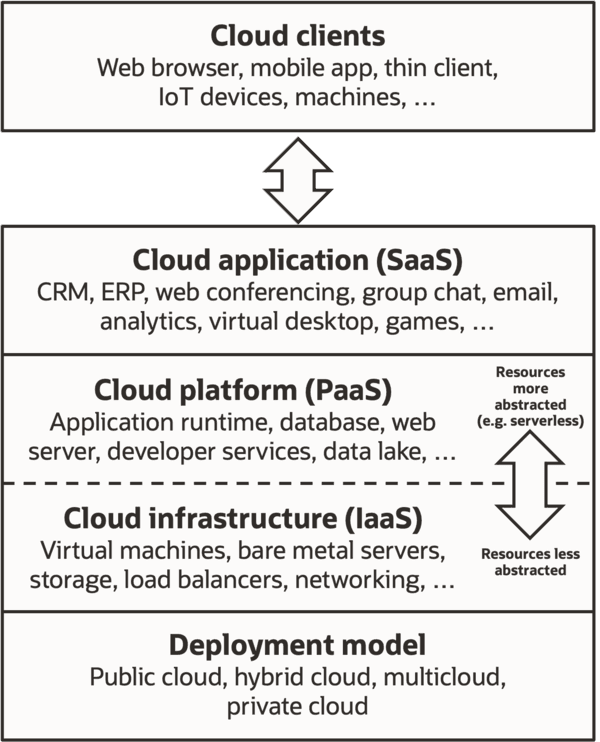
VMWare defines cloud infrastructure as follows:
Cloud computing infrastructure is the set of hardware and software components needed to facilitate cloud computing. It includes computing power, networking, and storage, as well as an interface for users to access their virtual resources. The virtual resources mirror a physical infrastructure, featuring components such as servers, network switches, memory, and storage clusters.
GAIA-X defines cloud infrastructure or cloud computing as follows:
Cloud computing refers to offering, using, and billing IT services in a way that is dynamically tailored to demand and delivered through a network. The range of services offered in the cloud computing context spans the entire spectrum of information technology—this includes infrastructure (e.g., processing power, storage space), platforms, and software.
In the 2008 article “A View of Cloud Computing,” Michael Armbrust et al. define cloud infrastructure as:
Cloud computing refers to both the applications provided as services over the Internet and the hardware and systems software in the data centers that deliver those services.
Armbrust et al. explain that the cloud can most readily be categorized by its accessibility method
The data center hardware and software is what we refer to as a cloud. When a cloud is available in a pay-as-you-go manner to the general public, we call it a public cloud; the service being sold is utility computing. We use the term private cloud to denote internal data centers of a business or other organization, not available to the general public, when they are sufficiently large to reap the benefits of cloud computing as discussed here.
VMWare defines cloud infrastructure as follows:
Cloud computing infrastructure is the set of hardware and software components needed to facilitate cloud computing. It includes computing power, networking, and storage, as well as an interface for users to access their virtual resources. The virtual resources mirror a physical infrastructure, featuring components such as servers, network switches, memory, and storage clusters.
GAIA-X defines cloud infrastructure or cloud computing as follows:
Cloud computing refers to offering, using, and billing IT services in a way that is dynamically tailored to demand and delivered through a network. The range of services offered in the cloud computing context spans the entire spectrum of information technology—this includes infrastructure (e.g., processing power, storage space), platforms, and software.
In the 2008 article “A View of Cloud Computing,” Michael Armbrust et al. define cloud infrastructure as:
Cloud computing refers to both the applications provided as services over the Internet and the hardware and systems software in the data centers that deliver those services.
Armbrust et al. explain that the cloud can most readily be categorized by its accessibility method
The data center hardware and software is what we refer to as a cloud. When a cloud is available in a pay-as-you-go manner to the general public, we call it a public cloud; the service being sold is utility computing. We use the term private cloud to denote internal data centers of a business or other organization, not available to the general public, when they are sufficiently large to reap the benefits of cloud computing as discussed here.