Hauptaussagen
Digital Infrastructure Gap
Transparenz bei digitalen Anbietern ist begrenzt
Sustainability challenges
Local impact is poorly communicated
Procurement practices show limited focus on sustainability or local sourcing.
About the Report
This report presents the findings of an evaluation of regional digital infrastructure and service providers headquartered in the Dutch province of Limburg, corresponding to the NUTS-2 region (NL42) as defined in European statistical and regional planning. Our evaluation focused on reviewing both digital policies and policies that may impact digital infrastructure development and performing market analysis. For the market analysis, we evaluated values-based performance (sustainability, transparency, and local impact). Our goal was to assess the state of digital infrastructure policies (vision, strategies, or objectives) as well as the regional market, assessing the local value creation and the environmental impact of IT infrastructure and service providers.
The evaluation revealed a lack of policies that shape the digital infrastructure market in the region. This is reflected in the market analysis which shows that providers in Limburg do not operationalize the regional ambitions when it comes to climate change, circularity, and regional economic development and do not deliver their full potential when it comes to sustainability and local impact.
Goals
Review existing digital policies and related policies (e.g., energy, climate, circular economy, economic development).
Assess the current state of the digital infrastructure market in Limburg.
Identify gaps between the region’s digital policy ambitions and the current state of its digital infrastructure market, particularly regarding sustainability, transparency, and regional value creation.
Highlight risks associated with the current direction of digitalization, especially if infrastructure remains imported, non-transparent, or lacks accountability.
Establish a framework for ongoing monitoring and development.
By identifying the region’s current status, this report provides policymakers and stakeholders with an objective perspective on the digital infrastructure market and lays the groundwork for shaping policies and monitoring future market development.
Limburg's Vision for a Sustainable Economy
The Province of Limburg is working toward an ambitious transformation, as outlined in their Coalition Agreement (Coalition Agreement 2023-2027): building a resilient, sustainable, and future-ready economy that creates opportunities for every resident ("Every Limburger Counts").
This includes:
Strengthening local industry clusters through applied digitalization
Limburg focuses on reinforcing its key economic domains—life sciences & health, agrotech, manufacturing, logistics, chemistry and e-commerce—by embedding digital solutions like AI, smart supply chains, and digital health applications that increase competitiveness and regional relevance.
Building a future-proof energy infrastructure
As mentioned in the Coalition Agreement (Coalition Agreement 2023-2027), Limburg is taking an active role in shaping its infrastructure to prevent bottlenecks—such as grid congestion—and to support the transition toward a circular, resilient economy. Future-proof infrastructure is essential for powering innovation, business transformation, and sustainable services across the region.
Building an adaptive education and workforce development system
With an aging population and shifting labor market needs, Limburg is investing in a regionally rooted system for training, retraining, and up-skilling its workforce. The province is working to build a flexible and inclusive education system that supports lifelong development, connects more directly with businesses, and equips residents with the skills needed for both the digital and circular economy. This includes the development of a Lifelong Development infrastructure, stronger collaboration between schools and employers, and targeted programs aimed at addressing labor shortages and creating future-proof job opportunities.
Investing in circular entrepreneurship and innovation
Limburg aims to achieve 50% circularity by 2030, aligning with the Netherlands’ broader sustainability and climate ambitions. This includes stimulating circular business models, accelerating innovation through public procurement (targeting 25% circular procurement by 2027), and acting as a launching customer to support sustainable SMEs. These efforts support the goals of the Dutch Climate Act (2019), which commits the country to reducing greenhouse gas emissions by 49% by 2030 and 95% by 2050, compared to 1990 levels. By reducing resource use, waste, and emissions across the economy, circularity plays a key role in helping Limburg contribute to these national climate targets from the ground up.
Enabling local production and economic resilience
The province emphasizes the importance of “being able to make things locally”—not only as a sustainability strategy but also as a means of strengthening sovereignty, retaining business activity, and increasing regional self-reliance.
While these ambitions outline a clear direction, Limburg’s own Strategic Exploration of the Digital Society in Limburg emphasizes that realizing them will require more than infrastructure and sectoral strategies alone. The province recognizes that digitalization is a broad societal transformation, one that affects nearly every domain—healthcare, education, energy, mobility, and governance.
To ensure this transformation benefits all residents, the province calls for a shared, value-driven digital vision—one that safeguards privacy, inclusivity, transparency, and autonomy as core public values. The strategy stresses the need for cross-sector collaboration between government, education, businesses, and social institutions, especially to ensure vulnerable groups are not left behind in an increasingly digital world.
At the same time, the province acknowledges that Limburg lags behind in terms of digital infrastructure and ICT sector development. Despite strong industrial and agri-food sectors, the regional digital backbone remains underdeveloped. However, this also presents an opportunity: Limburg can shape its digital ecosystem in a way that directly supports its broader economic and social goals.
In their Environmental Vision, Limburg outlines a strong commitment to sustainability and circular development, emphasizing the need for infrastructure that supports future needs. It highlights the importance of integrating digital and physical infrastructure, ensuring that spatial planning supports innovation, compact development, and resilient systems. The vision emphasizes infrastructure that is adaptable to climate challenges and aligned with broader circular and energy goals—creating the foundation for a digital ecosystem that contributes to both regional competitiveness and ecological wellbeing.
The strategic outlook identifies clear priorities to move forward: strengthening digital literacy, embedding ethical and public values into digital policies, enabling innovation through experimentation, and investing in secure, future-ready infrastructure. These elements are essential to building a digital society that is not only technically advanced but also socially inclusive, economically resilient, and locally grounded.
Beyond provincial ambitions, a wider set of strategies from both the province of Limburg and its municipalities shows a strong, shared commitment to sustainability, circularity, and digital transformation. Limburg’s own frameworks (Policy for a Future-Proof Economy and the Strategic Exploration of the Digital Society) make it clear that better digital infrastructure, digital inclusion and innovation across sectors like health, agrotech, manufacturing, and logistics are key priorities.
Similarly, local strategies such as Maastricht’s coalition agreement (2022-2026), Parkstad’s push toward energy neutrality and sustainability, and various municipal sustainability agendas highlight the importance of combining technology, circular practices, and cross-border cooperation to strengthen the province.
Turning this vision and goals into reality starts with a strong digital ecosystem—the foundational layer that enables every other part of the system to grow, connect, and deliver local impact. A digital ecosystem consists of infrastructure, providers, and competence to deliver on the societal goals set out by the region.
Limburg’s Provincial Strategy on Spatial Planning and the Environment recognizes that infrastructure alone isn’t enough. Demographic change, the energy transition, and digitalization are deeply intertwined—and navigating them successfully requires a regionally rooted, systematic, human-centered approach. That means investing not only in digital systems, but also in people: through re-skilling, education reform, and stronger collaboration between educators and employers.
Implementing the Vision: Securing Limburg's Digital Future
Um die oben beschriebenen Visionen und Ambitionen zu verwirklichen—sei es Zirkularität, digitale Inklusion, Innovationen in der Agrartechnologie oder zukunftssichere Energieinfrastruktur und Arbeitsmarkt—müssen digitale Infrastrukturen und Dienstleistungen nicht nur als technische Notwendigkeit, sondern als strategische Priorität betrachtet werden. Wird dieses Fundament mit Blick auf Regionalität, Nachhaltigkeit und Souveränität errichtet, kann es positive lokale Auswirkungen erleichtern und die Erreichung der von der Provinz gesetzten Ziele unterstützen.
Um die verschiedenen Schichten innerhalb des digitalen Ökosystems zu verstehen, haben wir eine ’Denkfabrik’ entwickelt, um die Politikgestaltung zu unterstützen. Sie zeigt, dass eine digitale Gesellschaft, Wirtschaft oder Verwaltung digitale Dienstleistungen benötigt. Digitale Dienstleistungen erfordern die Verfügbarkeit digitaler Technologien (‚Maschinen‘) und digitaler Ressourcen (‚Treibstoff‘).

With open-source, digital technology without IP-licensing is abundantly available. Digital resources can be accessed through regional IT infrastructure providers or sourced from global market operators (Cloud Providers).
Digital resources are generated by data centers, which combine ICT equipment and electricity. Data centers require substantial cooling for the ICT equipment as well as water, land, and materials.
The more this value-creation system—from digital services and technologies to resource production—is present in a region, the more sovereign that region becomes, and the greater the economic benefits. Conversely, if left unregulated, it can also increase the environmental burden for the region.
Each part of the value chain can also be imported from outside the region, potentially creating dependence and diminishing local value creation, but it can reduce regional resource consumption. Regions like Middle Franconia and Bavaria should make strategic decisions regarding acceptable levels of dependence, resource and land allocation, and the desired degree of local value creation. This can lead to digital infrastructure strategies that address this system holistically, addressing gaps and bottlenecks, thereby increasing the region's added value. Having more parts of the value chain locally also provides broader benefits: IT competence, job creation, and resilience to rapid supplier-driven changes.
Based on a national study for the German Ministry of Economic Affairs, we demonstrated job creation across the digital infrastructure value chain. The following overview assumes 1 Megawatt (1 MW) of power consumption for digital infrastructure in a region.
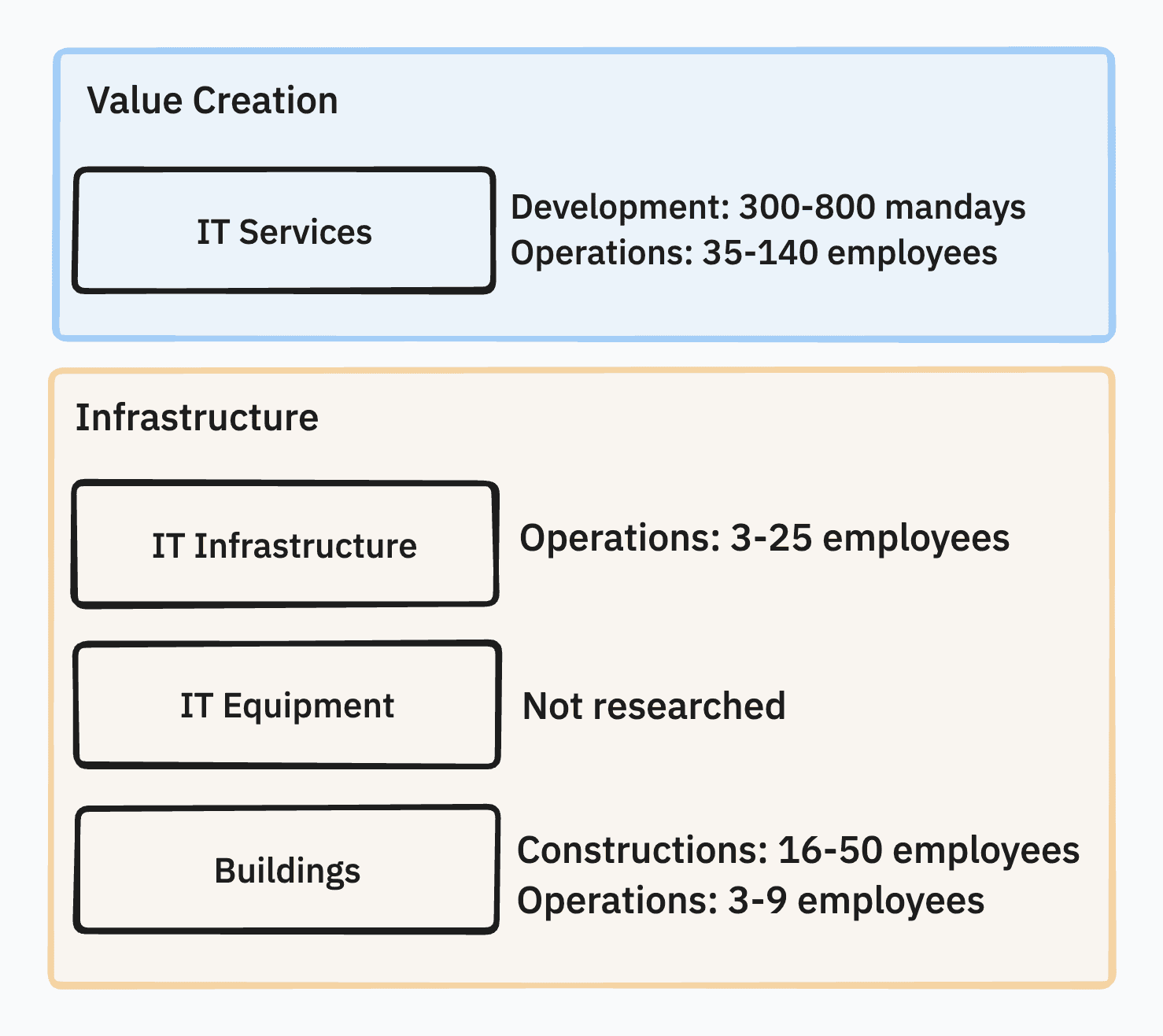
Vom Engpass zum Rückgrat: Digitale Lösungen für Energie Resilienz
Weltweit entwickeln sich Stromnetze zu Engpässen, die den Ausbau der erneuerbaren Energien verlangsamen, und die Niederlande sind ein Paradebeispiel dafür. Laut Statistics Netherlands (CBS) produzierten die Niederlande im Jahr 2023 insgesamt 120 Milliarden Kilowattstunden (kWh) Strom. Davon wurden 58,56 Milliarden kWh (ca. 49 %) aus fossilen Brennstoffen erzeugt, wobei Erdgas 44,84 Milliarden kWh (etwa 38 % der gesamten Stromerzeugung) ausmachte. Obwohl es klare Ambitionen gibt, den Verbrauch von fossilen Brennstoffen zu reduzieren und durch erneuerbare Energien zu ersetzen, treten aufgrund von Netzengpässen Herausforderungen auf.
Eine potenzielle Lösung fehlt in der Echtzeitprognose, die es den Energieverbrauchern ermöglichen würde, auf Netzengpässe zu reagieren, indem sie ihre Nachfrage anpassen.
In Provinzen wie Limburg behindern diese Netzbeschränkungen bereits den Fortschritt. Im Jahr 2022, stellte TenneT neue großflächige Netzanschlussanfragen in Teilen von Brabant und Limburg aufgrund von Kapazitätsengpässen ein, was effektiv den Eintritt neuer Stromverbraucher in das System blockierte. Laut der niederländischen Umweltplanungsagentur werden diese Netzverstauungsprobleme voraussichtlich nicht vor 2030 gelöst.
Die Chance
Das Problem der Engpässe bietet die Gelegenheit, neue digitale Dienstleistungen zu schaffen, die eine bessere Netzintegration von Energiekunden unterstützen und das regionale Stromnetz stärken. Indem die Herausforderungen des Energiesystems sichtbar gemacht und der Wert einer Lösung quantifiziert werden, entsteht ein potenzieller Markt für neue digitale Unternehmen, in dem sie innovieren können.
Wenn diese digitalen Produkte lokal produzierte digitale Ressourcen nutzen, verbleibt ein größerer Anteil der Wertschöpfung innerhalb der Provinz. Eine Analyse von Andreessen Horowitz, einer Silicon-Valley-Venture-Capital-Firma, zeigte, dass Start-ups bis zu 60 % ihrer Einnahmen für digitale Ressourcen ausgeben. Wenn digitale Unternehmen diese Ressourcen außerhalb von Limburg erwerben, geht diese Wertschöpfung für die Region verloren.
Ebenso können lokale Netzbetreiber und der Energiesektor IT-Dienstleister innerhalb der Provinz engagieren, um bei der Umsetzung der digitalen Produkte zu helfen, die innerhalb der digitalen Wirtschaft Limburgs errichtet werden. Diese Zusammenarbeit hilft dabei, Kompetenzen innerhalb der Provinz zu bewahren und Kooperationen zu fördern, die das Ziel eines zukunftssicheren Energiesystems unterstützen, während gleichzeitig digitale Fähigkeiten entwickelt und lokaler Wert geschaffen wird.
Zuletzt kann die Entwicklung lokaler digitaler Infrastrukturen, die tief in das Energiesystem integriert sind und auf Netzengpässe reagieren, die Ambitionen der Regionen weiter unterstützen. Ein solcher Ansatz stellt sicher, dass die Wertschöpfung aus der Produktion digitaler Ressourcen lokal bleibt.
Diese Schritte würden nicht nur dazu beitragen, Netzengpässe zu lindern; sie würden auch neue Chancen für lokale Unternehmen eröffnen, hochqualifizierte Arbeitsplätze schaffen und Limburgs Energie Resilienz stärken. Schließlich ist digitale Infrastruktur kein eigenständiges Gebiet. Sie ist das Rückgrat, das bestimmen wird, ob Limburgs Energieinfrastruktur nachhaltiger wird – oder über Jahre hinweg ein Engpass bleibt.
Die digitale Kluft durch regionale digitale Ökosysteme überwinden
Limburg steht vor einer doppelten Herausforderung: einer alternden Bevölkerung und einer digitalen Kluft. Viele Menschen in der Provinz (insbesondere ältere Einwohner und diejenigen außerhalb der städtischen Zentren) fehlen grundlegende digitale Fähigkeiten, was es ihnen erschwert, an einem zunehmend digital geprägten Arbeitsmarkt teilzunehmen. Gleichzeitig möchte die Provinz sicherstellen, dass Limburg ein attraktiver Lebens- und Arbeitsort bleibt, mit ausreichend lokalen Möglichkeiten sowohl für jüngere Generationen als auch für diejenigen, die in zukunftssichere Sektoren wechseln wollen.
Die Chance
Hier wird ein starkes regionales digitales Ökosystem unerlässlich. Digitale Infrastruktur allein wird das Problem nicht lösen. Doch in Kombination mit lokalen IT- und Digitalunternehmen, die aktiv in Bildung und die regionale Arbeitskraft investieren – durch digitale Fähigkeiten, Schulpartnerschaften und Umschulungsprogramme – kann ein starkes regionales digitales Ökosystem entstehen. Dieses Ökosystem unterstützt die Entwicklung und Bindung lokaler Talente, fördert Innovation und Wirtschaftswachstum und trägt dazu bei, dass niemand bei der digitalen Transformation zurückgelassen wird.
Stärkung regionaler Unternehmen durch ein digitales Ökosystem
Heutzutage wird ein Großteil der digitalen Infrastruktur Limburgs von außerhalb der Provinz bezogen – teilweise aus anderen Teilen der Niederlande oder Europas, aber überwiegend von US-amerikanischen Anbietern. Diese Anbieter betreiben große Marktplätze für digitale Ressourcen und Dienstleistungen ("Cloud"). Das liegt nicht daran, dass sie besser sind, sondern weil sie sichtbarer sind und Beziehungen zu vielen lokalen IT-Anbietern aufgebaut haben, um ihre Ressourcen und Dienstleistungen weiterzuverkaufen.
Diese Märkte sind mit einer Lock-in-Strategie konzipiert, die Unternehmen mit hohen Rabatten und kostenlosen Ressourcen lockt, nur um die Preise zu erhöhen, sobald der Kunde gebunden ist. Dies führt zu wirtschaftlicher Auszehrung – je mehr Unternehmen digitalisieren, indem sie ausländische Dienste nutzen und je mehr digitale Produkte mit digitalen Ressourcen aus diesen ausländischen Märkten gebaut werden, desto mehr Wert geht für eine Region verloren.
Lokale Anbieter, sowohl für Infrastruktur als auch Dienstleistungen, sind oft besser geeignet, um regionale Bedürfnisse zu erfüllen. Sie sind physisch näher, sprechen die lokale Sprache, passen sich besser an lokale Bedürfnisse an und tragen eher zur Wirtschaftskraft Limburgs, zur Entwicklung von Kompetenzen, zur Arbeitskraft und zu Zielen der Nachhaltigkeit bei. Folglich können sie auch aus der Provinz heraus reguliert und zur Rechenschaft gezogen werden. Trotzdem scheinen diese Vorteile allein nicht genug für eine breite Marktakzeptanz innerhalb Limburgs zu sein – wodurch eine weitgehend ungenutzte Möglichkeit zur Wertschöpfung entsteht.
Die Chance
Indem ein starkes regionales digitales Ökosystem ermöglicht wird, könnte Limburg von digitaler Abhängigkeit zu regionaler Selbstständigkeit und positivem lokalen Einfluss durch Jobkreation, Kompetenzentwicklung und Wirtschaftswertbeibehaltung wechseln.
Ein starkes regionales digitales Ökosystem:
Hält mehr wirtschaftlichen Wert in der Region durch lokale Jobkreation und Unternehmenswachstum aus der lokalen Produktion von digitalen Produkten, Ressourcen und Infrastruktur.
Unterstützt lokale Industriekonstellationen (Agrar-Lebensmittel, Fertigung, Logistik) mit digitalen Produkten, die auf ihre Bedürfnisse zugeschnitten sind und Produktivität sowie Wettbewerbsfähigkeit steigern.
Ermöglicht schnellere Reaktionen, größeres Vertrauen und mehr Kontrolle – insbesondere in Zeiten von Störungen oder geopolitischen Spannungen. Darüber hinaus können lokale Unternehmen im digitalen Ökosystem bei Bedarf überwacht und zur Rechenschaft gezogen werden.
Baut regionale Eigenständigkeit auf, indem lokale digitale Fähigkeiten und Infrastruktur entwickelt werden, was Limburgs wirtschaftliche Souveränität stärkt und gleichzeitig Nachhaltigkeitsziele unterstützt.
Um jedoch das volle Potenzial eines florierenden digitalen Ökosystems freizusetzen, muss alles mit Werten beginnen. Ohne Transparenz können wir Fortschritte nicht verfolgen. Ohne Verantwortlichkeit können wir keine Nachhaltigkeit sicherstellen. Und ohne eine regionale Strategie kann Limburg nicht von der Chance profitieren, das digitale Ökosystem in etwas zu verwandeln, das den Menschen und der lokalen Wirtschaft zugutekommt.
Mit anderen Worten, um Limburgs Wirtschaft zukunftssicher zu machen, geht es nicht nur darum, digitale Infrastruktur zu bauen. Es geht darum, ein regionales digitales Ökosystem zu fördern, das die Ziele und Ambitionen der Provinz unterstützt und gleichzeitig im Rahmen gesellschaftlicher Werte agiert. Limburg fängt nicht bei null an – es hat bereits eine starke Basis fähiger lokaler Akteure. Was fehlt, ist eine klare Strategie, um ihren Wert zu erkennen und ihr Potenzial zu nutzen.
The Risks of Inaction
As our analysis indicates, a substantial part of Limburg's current digital ecosystem is small, fragmented, and dependent on imported digital products, resources, and infrastructure.
This presents several risks:
Loss of digital skills: Limburg has one of the lowest numbers of digitally skilled individuals, with only 24% of the population having adequate digital skills as of 2023.
Demographic aging: The province is aging quickly, with more people over 50 and declining birth rates, reducing the pool of skilled working-age individuals.
Brain drain in the digital ecosystem: Limburg risks losing digitally skilled talent to other regions due to a lack of visible career pathways in advanced digital roles.
Increased dependence on foreign providers and loss of value creation
As Limburg continues to import digital resources and services from closed, foreign-owned markets to facilitate its digital transformation, the region becomes increasingly dependent.
This trend is mirrored on the national level:
According to estimates from The Netherlands Authority for Consumers and Markets (ACM), in 2020, Microsoft Azure held the largest share of the cloud market (40-45%), followed by AWS (30-35%), while Google Cloud Platform and Oracle each maintained market shares between 5-10%. In other words, international companies dominated 80-90% of the Netherlands' cloud market in 2020. On a European scale, Microsoft Azure, AWS, and GCP together hold more than 65% of the European cloud market.
This increasing reliance on a small number of non-European tech giants reduces regional control over infrastructure. More significantly, it results in missed opportunities for local value creation. As businesses depend on foreign digital services, which they must adapt to their specific needs, they often lack the expertise to do so. While local digital businesses can intervene by developing superior digital services, they still rely on imported digital resources (network capacity, compute, memory, and storage). As more components of digital value creation are outsourced, there are fewer incentives to enhance digital skills and capabilities in the province.
Loss of digital skills to build, implement, and operate digital services & infrastructure
Limburg is one of the provinces with the lowest number of digitally skilled people—those proficient in using the internet, software, and computers. A significant portion of Limburg’s population risks being left behind in the digital transition. In 2021, nearly 20% of individuals aged 12-75 had low digital skills, becoming increasingly vulnerable in today's digital society.
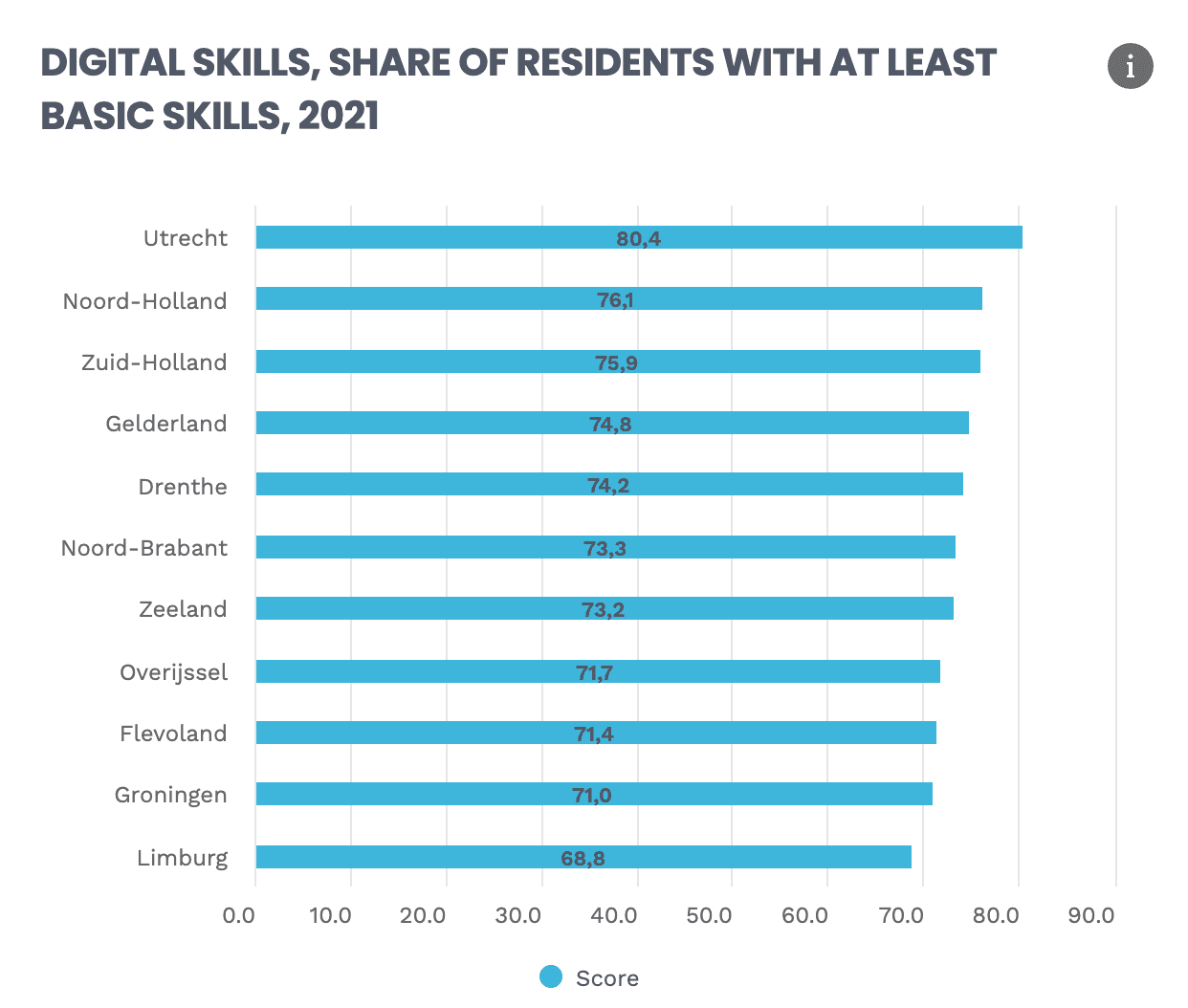
Neuere Daten des CBS (Centraal Bureau voor de Statistiek) zeigen, dass dieser Anteil 2023 auf 24 % gestiegen ist und auf eine wachsende digitale Kluft in Limburg hinweist. Diese Gruppe steht vor Herausforderungen bei der effektiven Nutzung digitaler Werkzeuge wie E-Mail, Websites, Online-Dienste und Apps, die zunehmend für die Teilnahme an Bildung, Beschäftigung und dem täglichen Leben erforderlich sind. Ohne gezielte Maßnahmen droht diese Kompetenzlücke, die soziale Ungleichheit zu vergrößern, den Zugang zu zukunftsfähigen Arbeitsplätzen einzuschränken und Limburgs Ambitionen für eine widerstandsfähige, innovationsgetriebene Wirtschaft zu untergraben.
Digitale Kompetenzen sind oft ein indirektes Nebenprodukt florierender digitaler Unternehmen und IT-Dienstleister. Wenn sie regional sind, können sie sich an der Kompetenzentwicklung in der Region beteiligen und haben einen Anreiz, sich in die Weiterbildung ihrer Gemeinschaft einzubringen – so können sie die digitalen Produkte nutzen, die sie bereitstellen.
Die demographische Alterung gefährdet die langfristige Wettbewerbsfähigkeit Limburgs
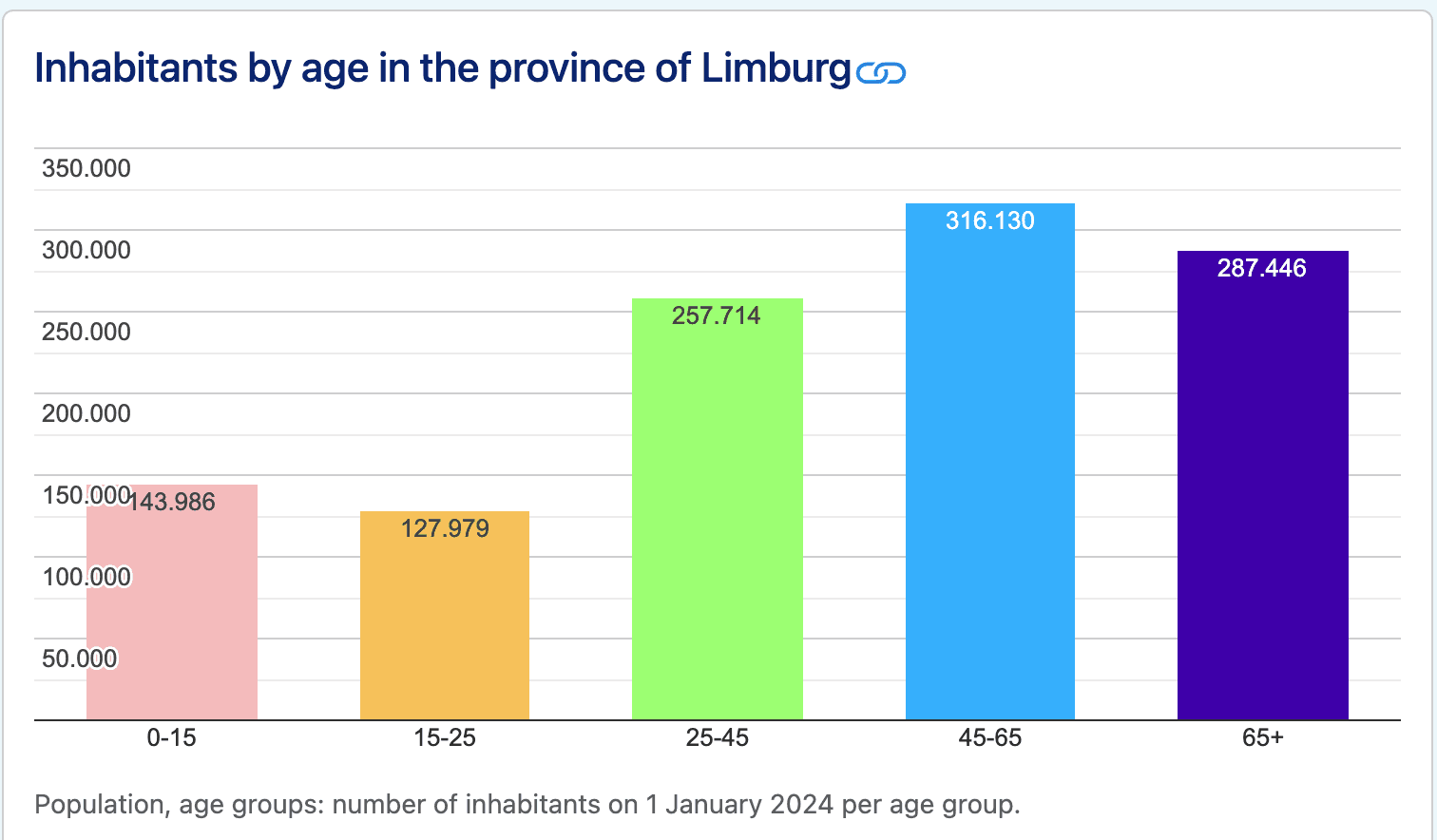
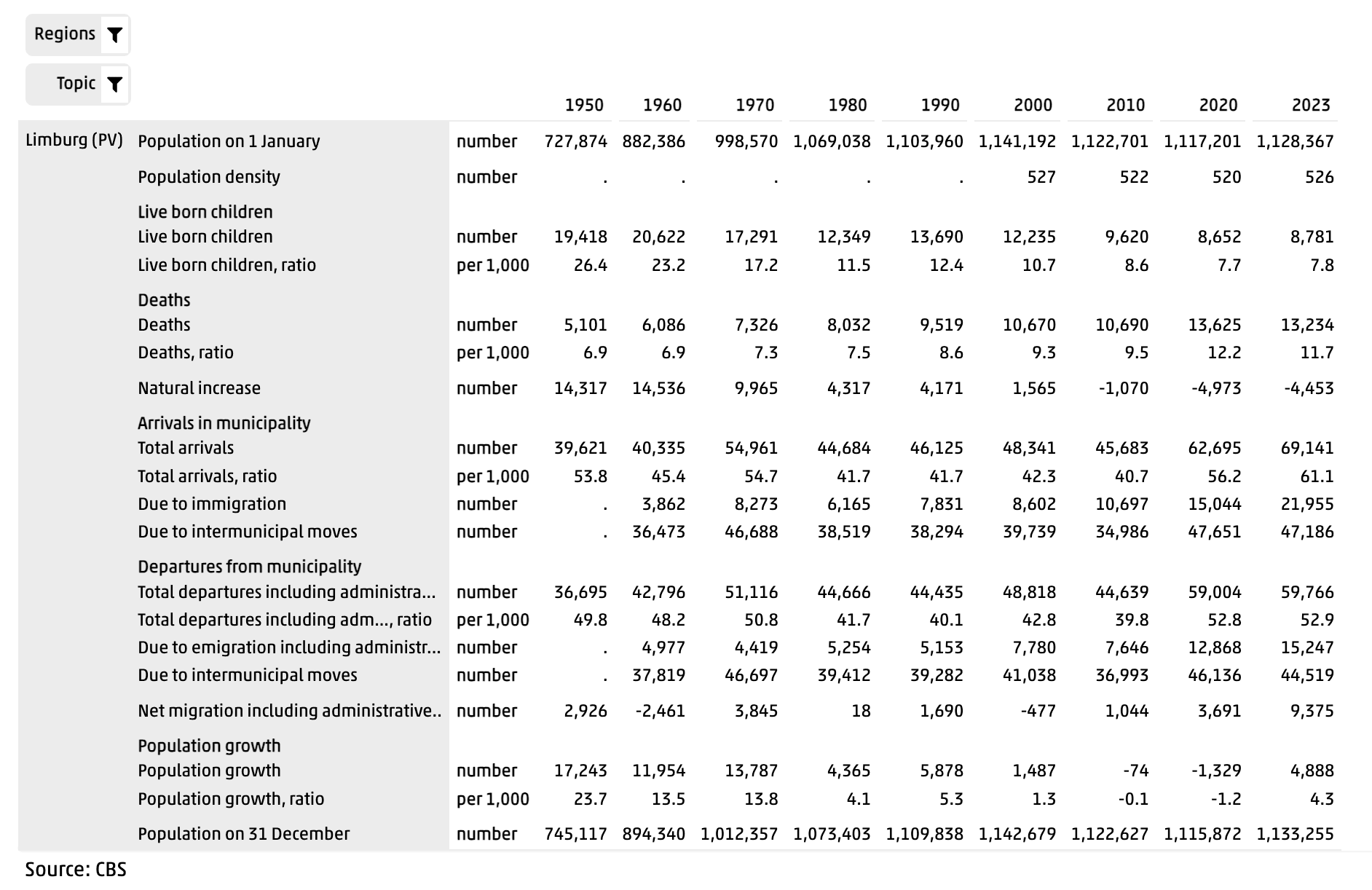
Während die Gesamtbevölkerung Limburgs in den letzten Jahren gewachsen ist, zeigt die Altersstruktur eine dringende Herausforderung: Die Region altert schnell. Die größten Bevölkerungsgruppen sind jetzt die über 50-Jährigen, während die Geburtenrate stetig gesunken ist und das natürliche Bevölkerungswachstum negativ geworden ist. Im Jahr 2023, zum Beispiel, starben mehr Menschen als geboren wurden, was einen in früheren Jahren beobachteten Trend fortsetzt.
Neuere Daten vom CBS (Centraal Bureau voor de Statistiek) zeigen, dass dieser Anteil 2023 auf 24% gestiegen ist, was auf eine zunehmende digitale Kluft in der Region hinweist. Diese Gruppe steht vor Herausforderungen bei der effektiven Nutzung digitaler Tools—wie E-Mail, Websites, Online-Dienste und Apps—die zunehmend wichtig für die Teilhabe an Bildung, Arbeit und Alltagsleben sind. Ohne gezielte Maßnahmen droht diese Fähigkeitslücke die soziale Ungleichheit zu verstärken, den Zugang zu zukunftssicheren Arbeitsplätzen zu begrenzen und die Ambitionen Limburgs für eine resiliente, innovationsgetriebene Wirtschaft zu untergraben.
Digitale Fähigkeiten sind oft ein indirektes Nebenprodukt blühender Digitalunternehmen und IT-Anbieter. Wenn sie regional tätig sind, können sie an der Kompetenzentwicklung in der Region teilnehmen und haben einen Anreiz, sich in die Weiterbildung ihrer Gemeinschaft einzubringen, damit sie die digitalen Produkte nutzen können, die sie bereitstellen.
Demografische Alterung gefährdet die langfristige Wettbewerbsfähigkeit von Limburg
Während die Gesamtbevölkerung in Limburg in den letzten Jahren gewachsen ist, zeigt die Altersstruktur eine dringende Herausforderung: die Region altert schnell. Die größten Bevölkerungsgruppen sind nun die über 50-Jährigen, während die Geburtenrate stetig gesunken ist und das natürliche Bevölkerungswachstum negativ geworden ist. Im Jahr 2023 beispielsweise sind mehr Menschen gestorben als geboren wurden, womit sich ein in den Vorjahren beobachteter Trend fortsetzt.
Diese Verschiebung verringert den Pool an qualifizierten Arbeitskräften, was Druck auf den Arbeitsmarkt, die Innovationsfähigkeit und die langfristige wirtschaftliche Nachhaltigkeit ausübt. Wenn ältere Einwohner in den Ruhestand gehen, wird es zunehmend dringlich, jüngere, digital versierte Arbeitskräfte anzuwerben und zu halten—nicht nur um die Produktivität aufrechtzuerhalten, sondern auch um sicherzustellen, dass wichtige Sektoren wie Gesundheitswesen, digitale Dienste und öffentliche Infrastruktur robust bleiben.
Dies erzeugt eine Abwärtsspirale: weniger lokale Arbeitsplätze → mehr Menschen ziehen weg → geringere Nachfrage und Investitionen → mehr Infrastrukturen und Dienstleistungen werden importiert → noch weniger lokale Arbeitsplätze.
Ein blühendes digitales Ökosystem kann Beschäftigungsmöglichkeiten für die nächste Generation von Einwohnern schaffen und auch die alternde Bevölkerung für den Wissenstransfer einbinden. Ältere Generationen besitzen oft tiefes Branchenwissen, das für die Entwicklung digitaler Dienste, die den Anforderungen verschiedener Industrien gerecht werden, von entscheidender Bedeutung ist. Da junge digitale Unternehmer oft über dieses spezifische Branchenwissen nicht verfügen, kann der generationenübergreifende Wissenstransfer zu gezielterer Innovation und zum Erfolg des digitalen Ökosystems führen.
Abwanderung im digitalen Ökosystem
Limburg läuft zunehmend Gefahr, seine digital talentierten Fachkräfte an andere Regionen oder Länder zu verlieren. Obwohl die Provinz in Bildung und digitale Kompetenz investiert, mangelt es an klar sichtbaren Karrierewegen in fortgeschrittenen digitalen Rollen—insbesondere im Vergleich zu Technologiezentren wie dem Randstad oder nahegelegenen deutschen Städten. Infolgedessen könnten junge Fachkräfte und Absolventen in den Bereichen IT, Data Science und Ingenieurwesen auf der Suche nach besseren Möglichkeiten, Innovationsökosystemen oder Karriereentwicklungen umziehen.
Dies kann durch ein regionales digitales Ökosystem angegangen werden. Indem die Digitalisierungsziele und -möglichkeiten in lokalen Unternehmen, Infrastrukturen und Regierungen sichtbar gemacht werden, können sich Möglichkeiten für neue digitale Produkte und Unternehmen ergeben (Unternehmer). Die Investition in lokale Fähigkeiten zur Produktion digitaler Ressourcen kann zu neuen hochqualifizierten Arbeitsplätzen führen. Schließlich kann die Implementierung digitaler Produkte in Geschäfts- und Regierungsprozessen zu weiteren Beschäftigungsmöglichkeiten für tech-nahe Arbeitskräfte führen - von Projekt- und Änderungsmanagement bis hin zu Personalwesen.
Evaluating the Digital Infrastructure in Limburg
The Sustainable Digital Infrastructure Alliance (SDIA) initiative aims to address the aforementioned challenges by promoting the development of value-driven, thriving digital ecosystems based on sustainability, transparency, and local impact. In the following section, we present our findings from our preliminary assessment. We highlight key performance indicators (KPIs) for determining the state of the regional digital ecosystem.
For many KPIs, data is missing or incomplete, in which case we use estimations and our own economic models to fill those gaps. Whenever estimations are used, this is clearly indicated in the footnotes of each metric.
Our overall conclusion is that Limburg, with its strategic location, has the potential to develop a distinctive digital ecosystem that operationalizes sustainability, transparency, and local impact. By fostering a balanced local ecosystem, the province can realize its larger ambitions and create more resilient economic growth while ensuring lasting positive local impact.
Detailed Analysis of Digital Infrastructure Market
Data center providers (DCP):
Among the data center providers assessed in Limburg, none published information on environmental impact, maintained a public sustainability or procurement strategy, nor mentioned any form of local impact.
Internet service providers (ISP):
None of the assessed ISPs published environmental impact data, or procurement or sustainability strategies. Only one company—Toren7—partially referenced local impact through its initiative to illuminate the Roermond television tower for public events and holidays.
IT infrastructure providers (IaaS):
None of the assessed IaaS providers published their environmental impact, procurement strategies, or local impact initiatives.
DynaLinq was the only provider in this group with a published CSR report, latest released in 2023. While DynaGroup outlined several sustainability-related initiatives (such as zero-emission transport, energy-efficient buildings, and repair/recycling programs), there was no evidence of regular, quantitative environmental reporting. The ESG report remained largely qualitative and did not include measurable indicators.
Cloud Infrastructure Providers (CIP):
None of the assessed CIPs published information about their sustainability strategy, procurement practices, or environmental impact. Open Line partially disclosed local impact initiatives through its involvement in digitalizing local governments and healthcare services.
Managed Service Providers (MSPs):
Sustainability strategies:
TrustTeam published a 2023 ESG report that included greenhouse gas assessments, marking a positive step toward transparency. However, additional environmental indicators (such as energy use, waste, or Scope 1–3 emissions) were not publicly available, nor was a 2024 update.
While several sustainability initiatives were outlined (e.g., renewable energy use, fleet electrification, DE&I policy, ISO 27001), the strategy lacked measurable targets, timelines, and a comprehensive framework for environmental impact reduction.
Procurement was briefly mentioned, but no publicly available criteria addressed sustainability, transparency, or local impact. Making such criteria and data accessible would strengthen TrustTeam's sustainability position.
DynaGroup outlined a broad sustainability strategy that included initiatives such as the Dyna TalentWheel (focused on employee development), Social2Gether (community engagement), recycling and repair programs, infrastructure sustainability, and the DynaHealth business unit. These reflected a clear commitment to sustainability across multiple areas. However, the strategy was primarily qualitative and did not include specific targets, metrics, or timelines related to reducing environmental impact. A more structured environmental strategy with measurable goals would strengthen this approach.
Kembit demonstrated a moderate commitment to sustainability and local impact. They outlined clear environmental objectives, including waste reduction, equipment reuse, energy efficiency, and collaboration with environmentally conscious suppliers.
NLcom showed signs of local engagement through regional partnerships and sponsorships.
Local engagement:
ZeroPlex demonstrated strong local engagement by sponsoring various regional organizations and events—including the Equestrian Association Zeldenrust, volleyball clubs Hovoc Horst and Civitas, Venlo On Ice, the Summer Park Festival, and The Venloop.
B/Focused highlighted its support for local community activities, such as sponsoring sports clubs and cultural events. These actions suggested a degree of local engagement, although detailed documentation or measurement of these initiatives was not provided.
Open Line and TCC partially contributed to local impact—Open Line through public sector digitalization, and TCC via social employment partnerships and youth IT training (DigiWise).
Toren7 partially referenced local impact through its initiative to illuminate the Roermond television tower for public events and holidays.
Kembit engaged locally through initiatives like the 100% Limburg Bike program and responsible hardware disposal in partnership with LEVANTO groep.
The remaining MSP providers assessed in Limburg did not demonstrate any publicly available commitments or initiatives related to sustainability, transparency, procurement criteria, or local impact. None of the MSPs evaluated published their environmental impact data.
Cloud service providers (CSP):
None of the CSPs assessed published sustainability strategies, environmental impact reports, procurement criteria, and did not show any local value creation or initiatives.
Hosting providers (HP):
Among the hosting providers, only B/Focused demonstrated local engagement through its support of community activities, including sponsorship of sports clubs and cultural events. While these efforts indicated some commitment to the local community, the company did not provide detailed information. None of the assessed hosting providers published sustainability or procurement strategies, or reported on environmental indicators.
Software as a service providers (SaaS):
Plan-IT started preparing for the CSRD (Corporate Sustainability Reporting Directive), demonstrating its intent to monitor and report impact. However, no environmental data or impact figures were published. The company stated it was working toward developing a sustainability strategy. In 2023, Plan-IT donated to a local food bank instead of giving Christmas gifts, showing some awareness of local social needs. However, broader or ongoing local engagement was not documented.
Phact demonstrated a moderate commitment to sustainability and local impact. While they outlined efforts like reducing energy use, using green hosting, and fostering inclusion, they did not publish their sustainability strategy or environmental impact data. Locally, they engaged through partnerships with educational institutions, internships, and support for regional talent development—indicating a degree of local value creation.
Genzai showed signs of local engagement through regional partnerships and sponsorships.
None of the other assessed SaaS providers published environmental performance data, sustainability or procurement strategies, or information about local impact.
Assessment Summary and Implications for Limburg’s Digital Future
Inconsistent Local Impact
While some providers demonstrate local engagement, most lack structured approaches to maximizing local value creation. Local impact is under-communicated. Many providers likely contribute to the regional economy—through employment, local procurement, or partnerships—but fail to make this visible. This represents a missed opportunity. As Limburg progresses toward developing a regional digital ecosystem, showcasing local contributions becomes essential to attract investment, gain public trust, and align infrastructure growth with regional development goals.
Underdeveloped Procurement Practices
None of the providers assessed publish procurement criteria that outline how they select their own suppliers—for example, whether they prioritize sustainable, transparent, or local sourcing when purchasing hardware, IT equipment, or services. While some providers informally mention working with local partners, these practices are not formalized or made publicly available. This lack of transparency limits the ability of public sector institutions—or sustainability-focused purchasers—to make informed decisions.
In a future-proof digital ecosystem, procurement is a powerful tool—not just for buyers, but also for providers themselves. Even though it is not always possible to source everything locally, clear procurement strategies that favor sustainable or regional suppliers where feasible can significantly boost local value creation, reduce reliance on global tech supply chains, and reinforce regional resilience.
Without published procurement standards, Limburg's digital infrastructure risks continued economic leakage, with value and opportunity flowing out of the region.
Limited Transparency
Transparency is a major blind spot—not only across Limburg’s digital infrastructure providers, but also as a broader trend within the industry. None of the assessed providers publish environmental performance data on a regular and comprehensive basis. While some providers have released occasional sustainability-related reports, these are often limited in scope, infrequently updated, and cover only a narrow set of indicators—typically focused on CO₂ emissions or renewable energy usage. Broader environmental metrics such as total energy consumption, water usage, waste generation, or biodiversity impact are rarely, if ever, disclosed.
Moreover, no provider maintains a public dashboard or reporting platform offering real-time or regularly updated environmental data. This lack of visibility makes it difficult for stakeholders to track progress, compare performance, or hold providers accountable.
Without transparent and ongoing reporting, Limburg faces serious challenges in building a sustainable and future-proof digital ecosystem—one that can align with broader climate goals, meet rising regulatory expectations, and earn the trust of regional stakeholders.
Absence of Sustainability Strategies
The lack of transparency around environmental impact makes it difficult to develop meaningful sustainability strategies. While a few providers have published CSR or ESG reports, these documents tend to be narrow in scope—typically limited to basic metrics such as CO₂ emissions or renewable energy use. Most lack measurable goals, defined timelines, or a broader set of environmental indicators like energy consumption, water usage, waste management, or biodiversity impact.
A comprehensive sustainability strategy should go beyond general commitments. It should clearly define how a provider intends to reduce its environmental footprint—supported by transparent data, concrete targets, and a timeline for implementation. Without this, it is impossible to track progress or ensure alignment with regional and national sustainability goals.