Hauptaussagen
Policy-Infrastructure Gap
Lack of market transparency
Excessive dependence on foreign providers
Local impact is poorly communicated
Sustainability Implementation Gap
About the Report
This report presents the findings from an evaluation of regional digital infrastructure and service providers headquartered in Middle Franconia, Germany. Our evaluation focused on reviewing digital policies and policies that may impact digital infrastructure development, as well as performing market analysis. For the market analysis, we assessed economic performance and values-based performance (sustainability, transparency, and local impact). Our goal was to examine the state of digital infrastructure policies (vision, strategies, or objectives) and the regional market, assessing local value creation and the environmental impact of IT infrastructure and service providers.
The evaluation revealed a lack of policies shaping the digital infrastructure market in the region. This finding is reflected in the market analysis section, which shows how providers in Middle Franconia:
do not implement regional ambitions regarding climate change, circularity, and regional economic development,
do not fully realize their potential concerning sustainability and local impact.
Goals
Review existing digital policies and related policies (e.g., energy, climate, circularity, economic development).
Assess the current state of the digital infrastructure market in Middle Franconia.
Identify gaps between the region’s digital policy goals and the current state of the region’s digital infrastructure market – particularly in areas like sustainability, transparency, and regional value creation.
Highlight risks associated with the current path of digitalization, especially if infrastructure continues to be imported, non-transparent, or unaccountable.
Establish a framework for ongoing monitoring and development.
By identifying where the region stands today, this report offers policymakers and stakeholders an objective perspective on the digital infrastructure market and lays the groundwork for shaping policies and monitoring future market development.
Middle Franconia and Its Digital Transformation
The digitalization and sustainability landscape of Middle Franconia, a cultural and historical region in northern Bavaria, is determined by both state and federal policies. The region's key cities – Nuremberg, and Erlangen – act as major technological and scientific centers. The region hosts global industry leaders such as Adidas, Puma, and Siemens, who play a crucial role in driving innovation and digital transformation throughout Middle Franconia.
The region's digital infrastructure is highly developed, with cities like Nuremberg leading in technological advancement. Approximately 10% of Nuremberg’s workforce is employed in the information and communications technology (ICT) sector [1], making it one of Germany's top 20 tech hubs. With over 100,000 employees across 7,000 companies and numerous international companies headquartered there, the Nuremberg metropolitan region is one of Europe's leading ICT locations. The region also excels in communications technology, embedded systems, open-source technologies, and specialized software solutions for automation and medical applications. This technological expertise is evident in Nuremberg's rank as the third-highest city in Europe for ICT patent quotas.
Influence at the State Level: Bavaria’s Role
Digital policies in Middle Franconia are predominantly shaped by the Bavarian State Ministry for Digital Affairs, which has crafted the Digital Plan Bavaria 2030 with the slogan: "Living better in a digital world!" The Digital Plan [2] addresses critical state-wide challenges across strategic areas such as digital education and skills, infrastructure and data, as well as security and network administration. The plan involves constant monitoring of Bavaria's digital advancement to allow for strategy modifications based on new technologies, societal needs, and arising challenges.
The primary goal of the digital plan is to ensure that all citizens, irrespective of age, background, or education, can engage in and gain from the digital transformation. This involves fostering media literacy in children to ensure they are not only digitally proficient but also secure in digital settings. A major aim is to develop digital public services that are seamless and accessible, thereby improving the efficiency and transparency of government interactions.
There is a strong emphasis on making rural areas as attractive and livable as cities, primarily through investing in broadband access and supporting local digital innovation. The plan also advocates for responsible data use and aims for digital sovereignty by promoting open-source tools and secure systems. Collaboration across all sectors (government, academia, businesses, and civil society) is deemed essential, with ongoing monitoring and evaluation ensuring the approach stays flexible and effective. However, despite these ambitions, foundational infrastructure remains insufficiently addressed – especially regarding sustainability, transparency, and local value retention.
Federal Framework: Germany’s Digital Strategy
Germany's Digital Strategy 2025 [3] defines the overarching goals for digital transformation nationwide. Key priorities include:
Developing a gigabit optical fiber network for Germany by 2025.
Supporting start-ups and promoting collaboration between young companies and established ones.
Creating a regulatory framework to boost investment and innovation.
Promoting smart networks in critical commercial infrastructure sectors of the economy.
Enhancing data security and developing informational autonomy.
Enabling new business models for SMEs, the skilled craft sector, and services.
Leveraging Industry 4.0 to modernize Germany as a production site.
Achieving excellence in research, development, and innovation in digital technology.
Integrating digital education into all stages of life.
Establishing a Digital Agency as a modern center of excellence.
These national objectives influence Bavaria’s policy landscape and are reflected in regional implementation across Middle Franconia.
Regional and Local Strengths
Nuremberg’s Vision: Purpose-driven Digital Transformation
In Middle Franconia with its administrative seat in Ansbach, Nuremberg plays a crucial role as the region’s technological and economic hub. It is acknowledged as one of Germany’s most advanced ICT cities, second only to Munich. Nuremberg boasts a vibrant startup ecosystem, anchored by institutions like ZOLLHOF–Tech Incubator, which supports high-tech entrepreneurship. The city also hosts NUEDIGITAL, one of the largest regional digital festivals in Germany, attracting thousands of participants and hundreds of organizations annually. Public innovation spaces such as FabLab and tollwerkstatt provide collaborative platforms for developers, creatives, and open-source communities. Moreover, digital public service portals like Mein.Nuernberg.de and the Integreat app enhance citizen participation and streamline administrative processes.
Nuremberg regards digitalization not solely as a technical advancement but as a fundamental transformation of urban society. Under its overarching strategy "Digital Nuremberg" [4], the city has developed a long-term vision for how digital technologies can enhance daily life and encourage sustainable urban development. This strategy is part of an integrated urban development concept (INSEK), recognizing the pervasive impact of digital change on all facets of city life – from governance and mobility to education, social inclusion, and citizen engagement. The city aims to leverage digital transformation to enhance transparency, participation, and co-creation; to bolster and safeguard local economic prosperity; and to drive more sustainable, resource-efficient urban development [5].
The essence of Nuremberg’s approach is clear: digitalization is not an end in itself. It should serve a broader purpose – making the city more livable, efficient, and inclusive. With this mindset, the city has initiated "Digitales Nürnberg" [6], a comprehensive strategy focused particularly on the digital transformation of city administration. This involves modernizing public services to make them more accessible and user-friendly while embedding sustainability and transparency into the city's digital frameworks.
The INSEK Digitales Nürnberg strategy [5] serves as a broad framework for the city’s digital transformation, guided by four strategic pillars:
Strengthening digital inclusion and sovereignty;
Securing and expanding digital infrastructure (public Wi-Fi, municipal IT modernization, infrastructure for new technologies like 5G);
Promoting innovation and digital skills;
Embedding digital solutions into urban sustainability and planning.
The strategy was collaboratively developed with input from local businesses, academia, startups, and citizens. A dedicated stakeholder group continues to guide its implementation, and a follow-up roadmap outlines concrete steps and timelines. Overall, it reflects Nuremberg’s commitment to ensuring that digitalization enhances quality of life, supports the local economy, and fosters inclusive, sustainable urban development.
Nuremberg has also committed to achieving climate neutrality by 2040 and reducing CO2 emissions by 65% by 2030 [7]. As a member of the "Circular Cities Declaration" (CCD), Nuremberg is committed to local circular economy development [8].
Fürth’s Digitalization Strategy for City Administration
The City of Fürth, although smaller, closely aligns with Bavaria’s digital strategy. It participates in state initiatives such as the Mittelstand-Digital Zentrum Franken, which provides tailored support to small and medium-sized enterprises embarking on digital transformation.
The City of Fürth has launched a comprehensive digitalization strategy [9] aimed at transforming its administrative functions. The strategy focuses on improving communication with citizens and businesses by offering personalized digital services and streamlining internal processes to boost efficiency, quality, and cost-effectiveness.
Fürth's digitalization strategy concentrates on five key areas:
Improving public services through digital channels,
Streamlining internal processes with document management systems,
Enhancing operational efficiency,
Improving transparency, and
Building internal digital governance capacity through dedicated roles and units.
Fürth has also implemented a digitalization strategy for its educational institutions [10]. Key elements include the adoption of Microsoft 365 and IServ as standard platforms across schools. The city has also established a dedicated Task Force for School Digitalization to oversee implementation and provide ongoing support. This initiative underscores Fürth's commitment to integrating digital technologies into education, preparing students for a digitally-driven future.
Fürth has also developed a sustainability strategy as part of its commitment to the UN Sustainable Development Goals (SDGs).
Key Focus Areas Include:
Climate and Energy – reducing emissions, promoting renewable energy, and improving energy efficiency in public infrastructure.
Education and Participation – promoting sustainability education, increasing digital access, and encouraging citizen engagement.
Social Inclusion – ensuring equal opportunities, supporting marginalized communities, and fostering intergenerational cooperation.
Sustainable Economy and Consumption – supporting circular economy practices, fair procurement, and responsible resource use.
Transparency and Governance – improving public access to information through tools like the interactive sustainability budget and integrating sustainability into city planning and budgeting processes.
Erlangen: Smart Innovation with a Sustainable Focus
Erlangen complements this landscape through its robust academic and research environment, notably the NHR@FAU High-Performance Computing Center, which advances AI and scientific computing across northern Bavaria. The city combines this technological prowess with a progressive municipal strategy focused on sustainability, transparency, and citizen engagement. Erlangen has also instituted a Sustainability Council composed of 26 member institutions, associations, and organizations – all experts in Sustainable Development Goals. The council advises the city administration and city council on sustainability issues based on the UN SDGs. Their focus includes energy conservation and efficiency, CO2-free heat supply, and other sustainability initiatives.
Smart city initiatives incorporate AI-driven chatbots for digital services, moisture sensors to manage urban greenery more efficiently, and a digital file management system aligned with Germany’s Online Access Act (OZG). These efforts modernize public administration, promote resource efficiency, and make daily interactions with the city more accessible and transparent for residents.
Conclusion
Despite these robust local initiatives, a persistent challenge remains: regional strategies focus greatly on digitalization and digital services while neglecting the infrastructure required to support them. The issues of who provides the infrastructure, how it aligns with local sustainability goals, and whether it supports regional value creation remain largely unresolved. Consequently, even the most forward-thinking digital strategies risk relying on imported digital infrastructure – limiting their potential to deliver long-standing, locally-rooted impact, while also aligning with the sustainability goals of the region.
The Hidden Gaps Undermining Regional Digital Resilience
Policy Focused on Accelerating Digitalization Without Addressing the Required Digital Infrastructure
While Bavaria’s Digital Plan 2030 and regional strategies across Middle Franconia actively support digitalization, particularly in areas like public administration, education, healthcare, and startup development, limited attention is paid to the underlying digital infrastructure that makes all of this possible. Beyond general references to broadband and mobile coverage, there is little focus on the actual capacity needed to produce and deliver digital services like servers, data centers, as well as the energy systems that power them. There is also little attention given to whether this infrastructure is provided by local companies or imported from abroad, which raises important sovereignty considerations. The priority remains to accelerate digitalization – without specifying where the underlying infrastructure comes from, what kind of ecosystem it supports, and whether it creates local economic value.
Such a lack of focus is not limited to the state level. The digital strategies of key cities like Nuremberg, Fürth, and Erlangen also fall short in addressing the need for transparent, locally rooted, and governed digital infrastructure – despite their leadership in smart city services and digital innovation.
As a result, a recurring and systemic gap emerges – while there is significant focus on digitalization across policies, the infrastructure that enables all of this is overlooked.

To address this shortcoming by understanding the various layers within the digital ecosystem, we have developed a 'School of Thought' to support policy making. By breaking it down into several components, it illustrates how a digital society, economy, or administration requires digital services. To remain active, digital services further require digital technologies ('machinery') and digital resources ('fuel').
With open-source, digital technology without IP licensing is widely available. Digital resources can be obtained either through regional IT infrastructure providers or from closed global market operators (Cloud Providers).
Moreover, digital resources are generated by data centers by combining ICT equipment and electricity. Data centers require significant cooling for ICT equipment as well as water, land, and materials.
The more this system of value creation (from digital services and technologies to resource production) exists in a region, the more sovereign that region becomes, and the greater the economic benefits. Conversely, if left unregulated, it can also increase the environmental burden on the region.
Each part of the value chain can also be imported from outside the region, which can create dependency and a loss of value creation for the region, while still avoiding resource use within the region. Regions like Middle Franconia and Bavaria should make strategic choices about the acceptable level of dependence, resource & land allocation, and desired local value creation. This approach can lead to digital infrastructure strategies that address this system as a whole, recognizing gaps and bottlenecks, and enhancing the added value for the region. Having more parts of the value chain locally also provides broader benefits: IT competence, job creation, and resilience to rapid changes imposed by suppliers.
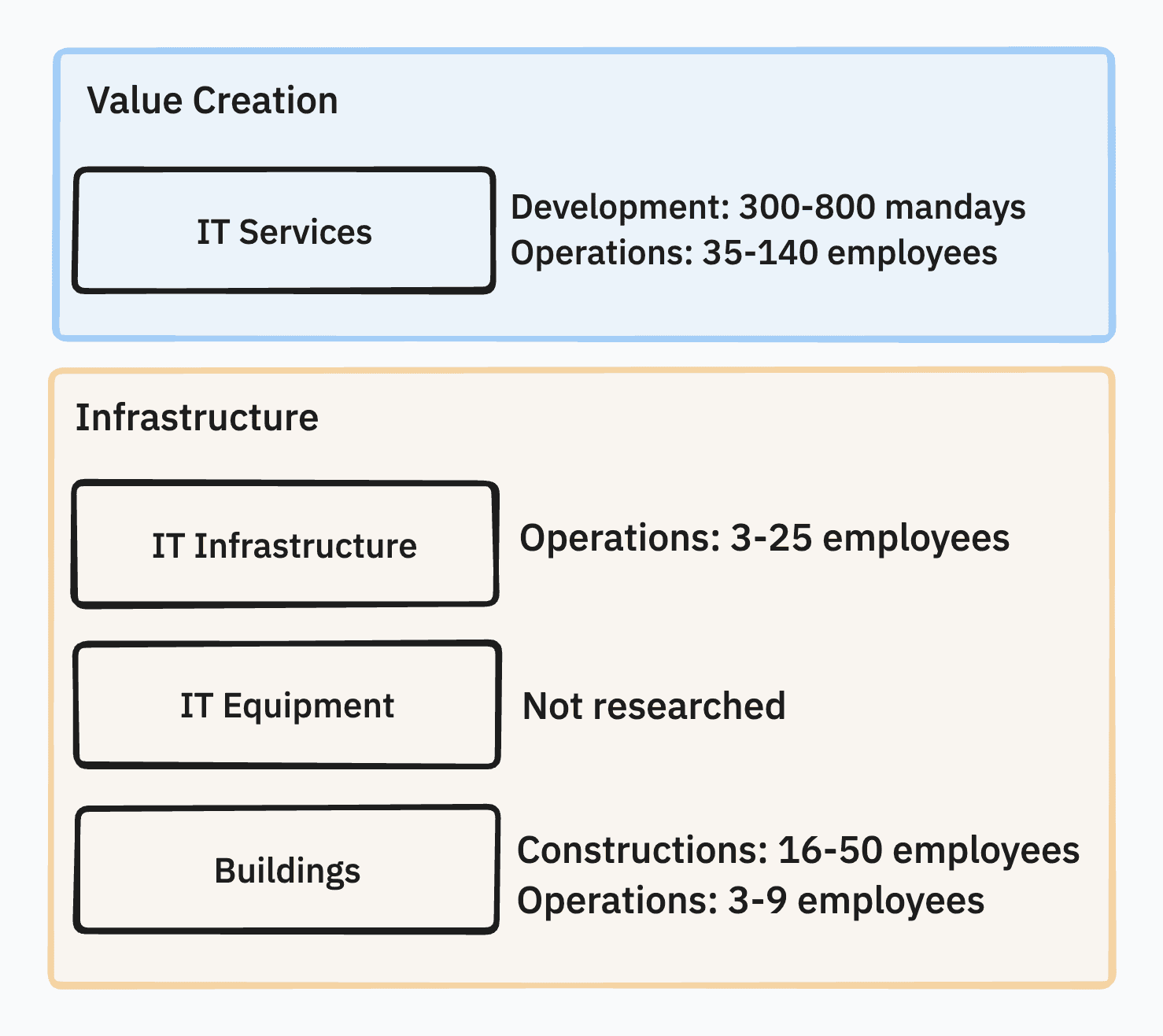
Based on our national study conducted on behalf of the Federal Ministry of Economic Affairs and Climate Change [11], we revealed the conditions for job creation across the digital infrastructure value chain (illustration below). The following overview is based on the assumption of 1 Megawatt (1 MW) of power consumption for the digital infrastructure in a region:
Die Gelegenheit
Der Aufbau eines starken regionalen digitalen Ökosystems besteht nicht nur darin, mehr digitale Dienstleistungen einzuführen. Es erfordert, dass „digital“ als ein einheitliches System verstanden und angegangen wird, das von Dienstleistungen über Marktdesign bis hin zu Infrastruktur reicht. Während Mittelfranken die öffentlichen Dienste, Bildung und Verwaltung aktiv digitalisiert, fehlt es an einer klaren Strategie dafür, wie (oder von wem) die zugrunde liegende digitale Infrastruktur bereitgestellt wird. Ohne dieses Fundament riskiert Mittelfranken, seine digitale Zukunft auf Systemen aufzubauen, die es nicht kontrolliert, wodurch sowohl die Fähigkeit verloren geht, Akteure in Bezug auf regionale Prioritäten zur Verantwortung zu ziehen, als auch die lokale Wertschöpfung verlorengeht.
Diese Herausforderung stellt jedoch auch eine Möglichkeit dar. Mittelfranken kann vom digitalen Konsum zur aktiven digitalen Wertschöpfung übergehen, indem es seine eigene digitale Infrastruktur und das digitale Ökosystem aktiv entwickelt und steuert. Anstatt sich auf importierte Infrastrukturen und Dienstleistungen zu verlassen, kann die Region ein lokal verankertes Ökosystem aufbauen, das den regionalen Prioritäten entspricht und gemeinsame Werte umsetzt.
Dadurch könnte Mittelfranken:
Wirtschaftlichen Wert in der Region halten, lokale Unternehmen unterstützen und hochqualifizierte Arbeitsplätze entlang der digitalen Wertschöpfungskette schaffen
Infrastruktur mit regionalen Nachhaltigkeits- und Energiezielen abgleichen durch den Einsatz erneuerbarer Energien, effizienter Kühlung und Kreislaufpraktiken
Die lokale Widerstandsfähigkeit stärken und Abhängigkeiten reduzieren, um sicherzustellen, dass digitale Systeme zugänglich, zuverlässig und von regionalen Akteuren verwaltet bleiben
Eine Basis für Innovation schaffen, indem Gemeinden, KMU und Start-ups die notwendige Infrastruktur für die Digitalisierung erhalten
Dies ist nicht nur ein technischer Wandel – es ist eine strategische Chance, die digitale Transformation in lokalen Stärken, Werten und dem langfristigen Wohlstand zu verankern.
Die Risiken
Die folgenden Risiken spiegeln nicht nur potenzielle zukünftige Herausforderungen wider, sondern sind bereits durch strukturelle Barrieren geprägt – einschließlich Marktkonzentration, langsamen Netzausbau und einer anhaltenden Kluft zwischen Digitalisierung und Infrastrukturplanung.
Mangel an Kontrolle und Verantwortlichkeit
Mittelfranken mangelt es derzeit an Transparenz über den Zustand seiner digitalen Infrastruktur. Regionale Strategien berücksichtigen selten, wer die zugrunde liegende Infrastruktur bereitstellt, wie sie verwaltet wird oder ob sie den Nachhaltigkeitszielen entspricht. Ohne diese Sichtbarkeit können öffentliche Behörden Anbieter nicht zur Verantwortung ziehen oder sicherstellen, dass die regionalen Prioritäten eingehalten werden.
Unvereinbarkeit mit Nachhaltigkeitszielen
Es gibt derzeit keine verlässliche Möglichkeit, die Umweltleistung von IT-Infrastruktur-Anbietern in der Region zu bewerten. Nur ein Anbieter veröffentlicht einen Nachhaltigkeitsbericht, der den ökologischen Fußabdruck nur teilweise erwähnt. Dadurch ist es unmöglich zu beurteilen, ob diese Unternehmen zu den Klima- und Nachhaltigkeitszielen der Region beitragen. Während Bayerns Digitalplan 2030 verantwortungsvollen Datengebrauch betont und die Strategie Nürnbergs Nachhaltigkeit und Ressourceneffizienz priorisiert, können wir ohne ausreichende Daten von Anbietern keine Übereinstimmung überprüfen.
Verringerte regionale Widerstandsfähigkeit
Die digitale Infrastruktur Mittelfrankens ist stark auf externe Akteure (hauptsächlich Hyperscaler ohne lokale Verantwortlichkeit) zur Bereitstellung kritischer digitaler Dienste angewiesen. Diese Abhängigkeit setzt die Region verschiedenen Verwundbarkeiten aus: Preisvolatilität, geopolitische Risiken und politische Änderungen außerhalb regionaler Kontrolle. Zudem schränkt die Marktdominanz dieser Hyperscaler die Entwicklung eines wettbewerbsfähigen lokalen Ökosystems aktiv ein, da lokale Akteure ohne proaktive Eingriffe Schwierigkeiten haben, in Bezug auf Preis, Umfang oder Sichtbarkeit zu konkurrieren.
Diese Herausforderungen werden durch die Einschränkungen des regionalen Stromnetzes weiter verschärft. Während Mittelfranken von einer relativ stabilen Energienfrastruktur profitiert, ist das Ausbautempo zu langsam um die wachsende Nachfrage zu decken – insbesondere, um neue digitale Infrastrukturen zu unterstützen. Anstatt sich ausschließlich auf den Bau neuer Kraftwerke zu verlassen, muss die Region innovative Lösungen erkunden, die die Energieeffizienz und die Flexibilität der Nachfrageseite verbessern und eine bessere lokale Systemintegration enthalten, um das digitale Wachstum nachhaltig zu unterstützen.
Um diese vernetzten Verwundbarkeiten anzugehen, sollten regionale Regierungen sich für nationale und EU-weite Politiken einsetzen, die fairen Wettbewerb fördern, die Netzwerkinfrastruktur modernisieren und Raum für lokale IT-Infrastruktur- & Dienstleistungsanbieter schaffen, um zu gedeihen.
Infrastrukturunterschiede und digitale Kluft
Mittelfranken sieht sich mit einer anhaltenden Kluft zwischen städtischer und ländlicher digitaler Infrastruktur konfrontiert. Während Städte wie Nürnberg und Fürth über eine solide Breitbandabdeckung verfügen, fehlt es vielen ländlichen Gebieten immer noch an Hochgeschwindigkeitsinternet. Ein Bericht der vbw aus dem Jahr 2024 zeigt, dass nur 16% der ländlichen Unternehmen in Bayern über Glasfaseranschlüsse verfügen, verglichen mit 41% in städtischen Gebieten [12]. Diese Glasfaserverbindungslücke ist besonders besorgniserregend, da digitale Ökosysteme auf einer starken interregionalen Konnektivität basieren – von Punkt-zu-Punkt-Breitbandabdeckung bis hin zu schnellem, zuverlässigem Zugang zu Internetknoten. Ohne gezielte Investitionen in den Glasfaserausbau könnten sich diese Unterschiede vertiefen und die Region riskiert, vom globalen digitalen Markt abgeschnitten zu werden. Für Unternehmen bedeutet dies, dass diejenigen, die digitalisieren möchten, möglicherweise nicht über die erforderliche Infrastruktur verfügen, was ihre Fähigkeit einschränkt, digitale Dienstleistungen zu exportieren und Kunden anzuziehen, die Hochgeschwindigkeitsinfrastruktur erfordern. Für Einwohner könnte dies zu weniger lokalen Arbeitsmöglichkeiten, eingeschränktem Zugang zu digitaler Bildung und einer wachsenden digitalen Kluft zwischen städtischen und ländlichen Gemeinschaften führen.
Stagnation bei Fähigkeiten und lokaler Innovationsfähigkeit
Deutschland steht vor bedeutenden Herausforderungen aufgrund des Mangels an qualifizierter und hochqualifizierter Arbeitskräfte, insbesondere im IKT-Sektor. Ohne regionale digitale Infrastruktur gibt es weniger Möglichkeiten für lokale Arbeitskräfte, praktische Erfahrung und Kompetenz zu entwickeln. Ohne einen vielfältigen Infrastruktumarkt gibt es weniger lokale Unternehmen, die in Schulungen oder Bildung investieren können. Ein florierendes lokales digitales Ökosystem zieht nicht nur Talente in die Region – es schafft auch Möglichkeiten, neue Kompetenzen und Fähigkeiten in der Region zu entwickeln.
Trennung zwischen digitalen und energiepolitischen Übergangsstrategien
Die 2024 von der LBBW [13] durchgeführte Studie unterstreicht, dass Deutschlands Energie- und digitale Infrastruktur entscheidend für seine Wettbewerbsfähigkeit als Wirtschaftsstandort ist. Sie zeigt, dass Schwächen in diesen Sektoren Unternehmen dazu veranlassen, Kapazitäten ins Ausland zu verlegen, wobei 23% dies bereits getan haben und 38% weitere Schritte in Erwägung ziehen. Eine signifikante Mehrheit, 90% der befragten Unternehmen, plant, in ihre eigene Energieversorgung zu investieren, um Abhängigkeiten zu reduzieren. Allerdings glauben 78%, dass die derzeitige Wirtschaftspolitik das Potenzial des Energieübergangs gefährdet. Die Studie betont, dass die Energiewende ohne effiziente digitale Infrastruktur nicht gelingen kann, und hebt die Notwendigkeit hervor, dass koordinierte öffentliche und private Sektorinitiativen Deutschlands Infrastruktureresilienz verbessern.
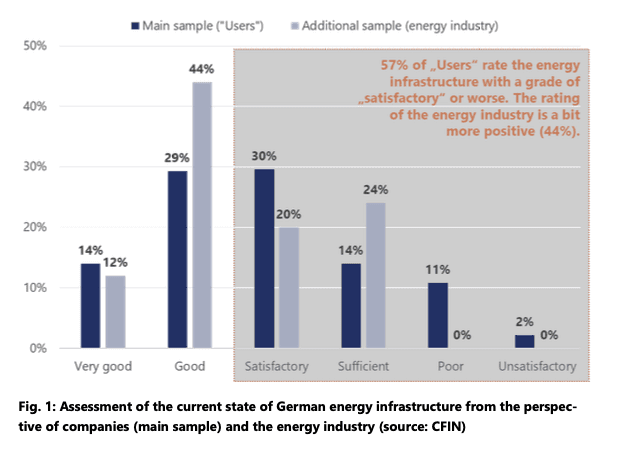
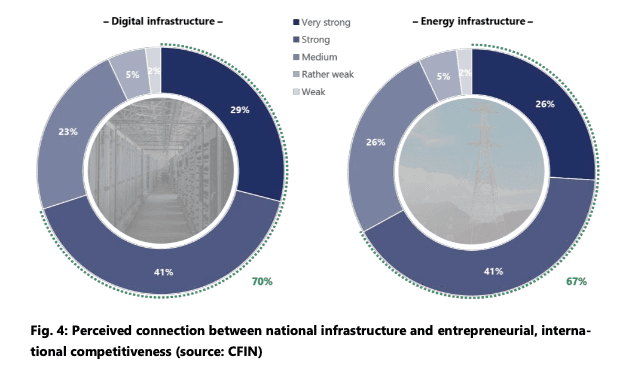
The connection between digital and energy infrastructure plays a key role in the competitiveness of German companies.
Dependence on Foreign Providers and Loss of Value Creation
Germany's cloud market, like much of Europe, is heavily dominated by a few American tech giants. In 2020, 75–90% of the EU cloud market share was held by Amazon Web Services (AWS), Microsoft Azure, and Google Cloud Platform [14].
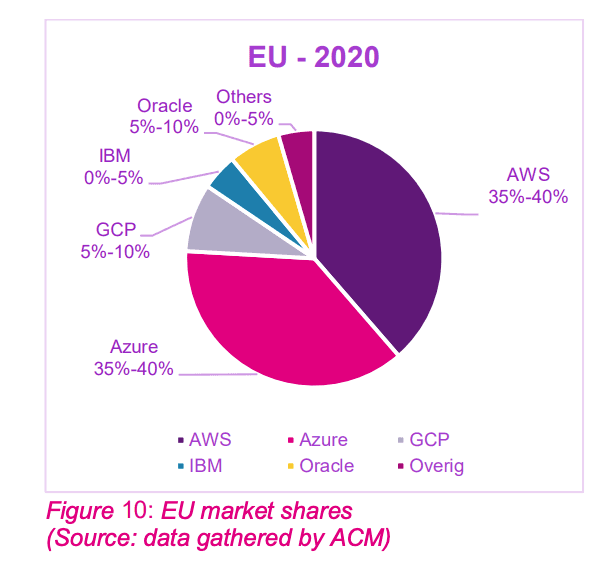
Source: ACM [15] Note: Due to the lack of comprehensive German market data, the Netherlands is shown as a representative example above.
This increasing dependency on a few non-European tech giants reduces regional control over critical infrastructure and results in missed opportunities for local value creation. Businesses are reliant on digital infrastructure and services that, although available, are not tailored to their specific needs. Conversely, regional providers rooted in local contexts speak the language and can offer more customized solutions – yet they struggle to compete due to market barriers and unfair practices by cloud providers such as egress fees, restrictions on interoperability, and committed spend discounts [16]. By depending on foreign companies for critical digital infrastructure, Middle Franconia forfeits the opportunity to cultivate its own regional digital ecosystem, with infrastructure, services, and competencies.
Local digital businesses and startups could intervene and develop superior digital services; however, they are still reliant on imported digital resources due to the lack of adequate available infrastructure. As more segments of digital value creation are outsourced, the incentives to build and enhance digital skills and capabilities in the region diminish. The region is reduced to a mere consumer of digital services and resources, unable to shape its digital future and enhance the competitiveness of the local economy via digital innovation.
The opportunity
Local IT infrastructure and service providers are often better equipped to address regional needs. They are closer, speak the local language, and better adapt to local needs, increasing the likelihood of contributing to Middle Franconia’s economy, skill development, workforce, and sustainability goals. Additionally, they can be regulated and held accountable from within the region. Yet, these advantages alone do not seem sufficient for extensive market adoption in Middle Franconia – creating a largely untapped opportunity for value creation.
By fostering a robust regional digital ecosystem, Middle Franconia could transition from digital dependency to regional self-reliance and beneficial local impact through job creation, skills development, and economic value retention.
As a result, Middle Franconia could:
retain more economic value within the region via local job creation and business growth derived from the local production of digital products, resources, and infrastructure
support local non-digital industry clusters with digital services tailored to their needs, enhancing productivity and competitiveness
achieve agility, greater trust, and more control – key factors for accelerating digitalization in the local economy and society – especially during times of geopolitical tension
promote accountability – local companies in the digital ecosystem can be monitored and held accountable
foster self-reliance by developing local digital capabilities and infrastructure, strengthening Middle Franconia’s economic sovereignty while supporting sustainability goals
To unlock the full potential of a thriving digital ecosystem, it all must begin with values. Without transparency, we can't track progress and hold providers accountable. Without accountability, we can't ensure sustainability. And without a regional strategy, Middle Franconia misses the chance to transform the digital ecosystem into something that benefits the people and local economy.
The risks
Increasing dependence on non-European providers and diminishing local value creation
Middle Franconia's growing reliance on foreign-owned cloud and infrastructure platforms undermines its digital sovereignty and weakens regional economic resilience. As digital services and resources are imported from closed ecosystems abroad, local infrastructure remains underdeveloped. This results in a downward spiral: limited investment in local infrastructure → weaker local providers → more reliance on foreign platforms → reduced regional control and value creation → fewer local jobs and skills development → even deeper dependence.
Constrained growth of regional infrastructure providers
Local infrastructure and service providers often struggle against dominant global players. Without political recognition or policy support, these regional companies are overlooked, underutilized, and unable to scale – despite being better positioned to meet local needs and often outperforming hyperscalers on local impact or sustainability.
Reduced trust, visibility, and accountability
When infrastructure is managed by non-European actors, assessing contributions to the local economy or understanding data processing, resource utilization, and operations’ adherence to local sustainability standards becomes challenging. This weakens public trust and diminishes the capacity of regional authorities to shape a market that delivers positive societal outcomes.
Shortage of IT specialists
In 2023, Middle Franconia's workforce surpassed 1.04 million according to EURES [17]. Among them, 4.9% held a tertiary degree, 47.7% had completed secondary education, and 17.5% had only primary education. The region’s employment rate stood at 62%, marking an increase of 1.2 percentage points from 2022 and placing it 2.4 points above the national average in Germany. Despite this strong employment performance, employers across the region – particularly in IT and tech-driven sectors – face persistent challenges in finding qualified specialists. The shortage is not solely a numbers issue but also one of specialization, as the market lacks professionals with up-to-date digital and technical expertise.
A thriving digital ecosystem can mitigate this challenge by creating enticing job opportunities for the next generation of local residents while engaging the aging workforce in meaningful ways. Older professionals often possess deep sector knowledge crucial for developing digital solutions tailored to real industry needs. Meanwhile, younger digital entrepreneurs might bring technical skills but often lack this embedded expertise. Facilitating inter-generational collaboration can therefore encourage focused innovation, practical implementation, and the long-term success of the region’s digital transformation.
Limited influence in shaping Middle Franconia's digital future
By relying on foreign providers, Middle Franconia loses the ability to shape its own digital future. These external actors are not accountable to regional policy goals and often operate without considering local climate targets, procurement criteria, or digital inclusion efforts. As a result, the region has limited leverage to influence how digital infrastructure develops, hindering alignment of digitalization with broader sustainability, transparency, and economic development strategies.
Evaluating the Digital Infrastructure in Middle Franconia
The Sustainable Digital Infrastructure Alliance (SDIA) initiative seeks to address the aforementioned challenges by promoting the creation of value-driven, flourishing digital ecosystems rooted in sustainability, transparency, and local impact. In the following section, we present our findings from the preliminary assessment. We emphasize key performance indicators (KPIs) for evaluating the condition of the regional digital ecosystem.
For many KPIs, data is either missing or incomplete. In such instances, we utilize estimations and our economic models to bridge these gaps. When estimations are used, we clearly annotate this in the footnotes of each metric.
Detailed Analysis of the Digital Infrastructure Market
Data Center Providers (DCP):
Among the DCPs evaluated in Middle Franconia, none publicly disclosed information on environmental impact, a public sustainability strategy, or procurement criteria. Furthermore, no provider clearly communicated local impact initiatives. A partial exception is noris network, which highlights its partnership with the City of Nuremberg to modernize digital infrastructure. While this indicates some regional involvement, it does not frame a structured local impact strategy. This overlooks an opportunity, as regional providers could set themselves apart from global tech giants by visibly showcasing their contributions to the region.
Internet Service Providers (ISP):
None of the ISPs assessed published data on environmental impact, procurement policies, or sustainability strategies. Additionally, no companies mentioned community engagement or local contributions on their websites.
IT Infrastructure Providers (IaaS):
None of the IaaS providers assessed published data on environmental impact, procurement policies, or sustainability strategies. Moreover, no companies indicated community engagement or local contributions on their websites. A partial exception is noris network, highlighting its cooperation with the City of Nuremberg to enhance digital infrastructure. While this suggests regional engagement, a structured local impact strategy is not framed.
Cloud Infrastructure Providers (CIP):
None of the CIPs published sustainability strategies or shared data on environmental impact on their websites. Additionally, none made procurement criteria publicly available and did not publish local impact initiatives.
Managed Service Providers (MSPs):
Several providers show partial local engagement:
ProMX sponsors local sports teams and the Nuremberg Zoo's penguin feeding program and is part of Bavaria’s LBV conservation society.
Noris network highlights cooperation with the City of Nuremberg to modernize digital infrastructure.
Xeomueller partners with a range of local organizations including non-profits, small businesses, and educational institutions, supporting regional digital transformation.
Intellity organizes user groups across cities, including Nuremberg and Munich, promoting knowledge exchange and IT up-skilling.
OnIT highlights numerous digitalization projects for local municipalities, aiding digital transformation at the local level.
However, none of the assessed MSPs published strategies on sustainability, procurement criteria, or data on environmental impact.
Cloud Service Providers (CSP):
None of the CSPs evaluated published procurement criteria, sustainability strategies, or environmental impact data. They also did not report on the impact on local communities.
Hosting Providers (HP):
No assessed hosting providers published strategies on sustainability or environmental data. Public procurement policies were equally absent. However, two providers demonstrated partial local impact:
Xeomueller partners with various local organizations including non-profits, small businesses, and educational institutions, supporting regional digital transformation.
OnIT highlights numerous digitalization projects for local municipalities, supporting digital transformation at the regional level.
Software as a Service Providers (SaaS):
DATEV stands out as the sole SaaS company to publish a sustainability report. Their 2023 report encompassed key environmental metrics, including CO₂e emissions, resource consumption, and waste management. While they displayed ISO 50001 certification and green IT initiatives, clearer targets and more detailed data center performance metrics would enhance the report. No other company published sustainability reports or environmental impact data.
DATEV was also the only company to publish procurement criteria, though on a limited basis.
Two SaaS companies showed a commitment to local impact. ProMX actively supports the community through sports sponsorships and conservation initiatives, including the Nuremberg Zoo and Bavaria's LBV conservation society. DATEV contributes through multiple initiatives, including education support, hardware recycling programs, and the Nuremberg World Farm project, which promotes sustainable agriculture and biodiversity. In July 2023, DATEV also installed six bee colonies at their site to support local biodiversity.
Assessment Summary and Implications for Middle Franconia’s Digital Future
Lack of Transparency Hinders Effective Market Monitoring & Policy Development
The vast majority of providers do not publish data on environmental performance, sustainability strategies, or procurement criteria. Most operate without clear public documentation of their environmental impact or sourcing practices. This lack of transparency makes it challenging for stakeholders, particularly public institutions and sustainability-focused customers, to make well-informed, responsible decisions.
This represents a missed opportunity to align digitalization with circular economy principles and local economic development, which is significant given Nuremberg's commitment as a member of the "Circular Cities Declaration" to achieving a more sustainable local circular economy. With Germany's new National Circular Economy Strategy aiming to retain raw materials in circulation for as long as possible and reduce primary resource consumption (BMUKN: The National Circular Economy Strategy (NCES) [18]), digital infrastructure providers in Middle Franconia are not fully supporting regional policy objectives that could enhance procurement power to fortify local circular economy ecosystems and advance the region's sustainability goals.
Sustainability Strategies are Rare and Misaligned with Regional Goals
Only DATEV has published a sustainability report, yet it remains largely qualitative, without clear KPIs, measurable reduction targets, or concrete timelines. This contrasts sharply with the ambitious sustainability commitments made by cities in Middle Franconia. Nuremberg, as a signatory of the "Circular Cities Declaration," has pledged to build a sustainable local circular economy, while Fürth has established clear carbon neutrality targets for 2035. Erlangen's climate action plan incorporates specific digital sustainability requirements.
The lack of robust, actionable sustainability frameworks from digital infrastructure providers suggests environmental impact is not yet a core strategic concern and reveals a significant misalignment with the region's established sustainability priorities.
Procurement Practices are Largely Invisible
Across all categories, only one company (DATEV) has made procurement criteria publicly available. No other providers indicate supplier selection processes, priorities for sustainable sourcing, or considerations for transparency or regional value creation in their procurement. This is a lost opportunity to harmonize digitalization with Bavaria’s recognized need for "circular material" and "sustainable bzw. zirkuläre Vorhaben" [19] (sustainable and circular projects), which are gaining increased support through state investments and research programs.
Given Bavaria's focus on supporting companies with circular product designs, optimized product utilization, and recovery of materials at product life end through initiatives like CIRCULAR4.0 [20], transparent procurement practices could be a pivotal mechanism for Middle Franconian digitalization providers to demonstrate alignment with regional circular economy goals and strengthen local value chains.
Local Impact is Present – but Inconsistent and Under-communicated
Some providers engage in regional activities, from partnerships with local institutions (e.g., Noris network and the City of Nuremberg) to sponsorships of community events or educational programs (e.g., ProMX, Intellity, Xeomueller). However, these efforts are often ad hoc, not well communicated, or visible. Most companies do not explicitly communicate their contributions to regional development, community well-being, or local employment. Consequently, valuable contributions often remain unseen, diminishing the perceived relevance of these providers in supporting Middle Franconia’s long-term goals for sustainability, innovation, and resilience.
Conclusion
The digital infrastructure market in Middle Franconia has a solid technical foundation and a strong base of regional providers. However, to build a thriving digital ecosystem, the region must go beyond digitalization for its own sake. This means:
Recognizing digital infrastructure as a strategic layer – not merely as an enabler, but as a domain that must be sustainable, transparent, and locally rooted
Encouraging providers to publish environmental data, procurement criteria, and local engagement efforts
Creating incentives and support mechanisms (e.g., public procurement rules, funding programs) that reward sustainable and transparent practices
Only by doing this can Middle Franconia transition from a region that uses digital infrastructure to one that builds and governs it – ensuring that the value created by digitalization remains within the region and supports its long-term goals.